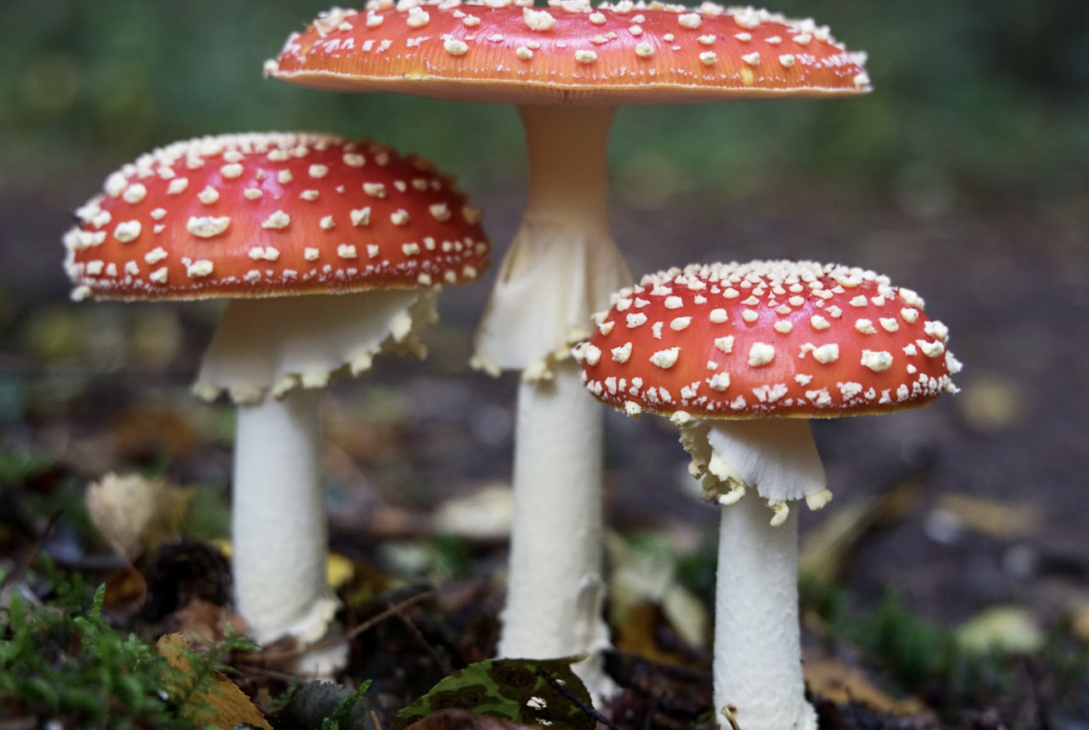
Image of Mushrooms by Hans Veth | Unsplash
Imagine you are on a walk, strolling through the forest together with some friends. You notice sway and movements of nature, the chirping from birds, the bristling of bushes and leaves on trees. But what you may not notice, is that below your very feet lies a broad, hidden networking system, linking tress and plants together, whilst no one realises. When most people think of fungi, they first imagine the mushrooms that appear in a forest, or the mould that grows on food, or even the mushrooms that are globally eaten. But what most people don’t picture, is a widely interconnected trade and networking system that takes place all around us.
Fungi have their own separate and distinct kingdom, different from both animal and plant kingdoms. Instead of photosynthesising to receive their nutrients, fungi absorb nutrients from their surrounding environments. What humans tend to visually see and associate with fungi – yeasts, moulds, fungi – are simply the reproductive end of a much larger kingdom and reality. The root-like structure of a fungus is known as “mycelium”, which is a networking system of threads referred to as “hyphae”, which spread underground, unnoticed [1].
Fungi are incredibly diverse, with scientists estimating there might be around 2.5 million species of fungi on Earth, however, only about 10% of this estimate have been discovered and described [2] . Some of these species are microscopic, and others are vast. One might think that the largest organism might be a blue whale, however, a single honey fungus – “humongous fungus” (armillaria ostoyae), spreads across 2835 acres of forest, located in Oregon’s Blue Mountains. It is thousands years old, expressing how robust and expansive fungi networks can actually be. [3].
Arguably the fungi’s most extraordinary role is their ability to communicate and connect with plants. Many fungi form “mycorrhizal relationships” – partnerships with roots of trees, where the fungus is able to receive sugars from the plant made from photosynthesis, and the plant gains increased access to soil, water and soil nutrients like phosphorus and nitrogen. Furthermore, there is much more to the fungi’s job than simply trading with single trees at a time. Instead, they connect multiple plants into a vast system underground, commonly referred to as the “wood wide web”.
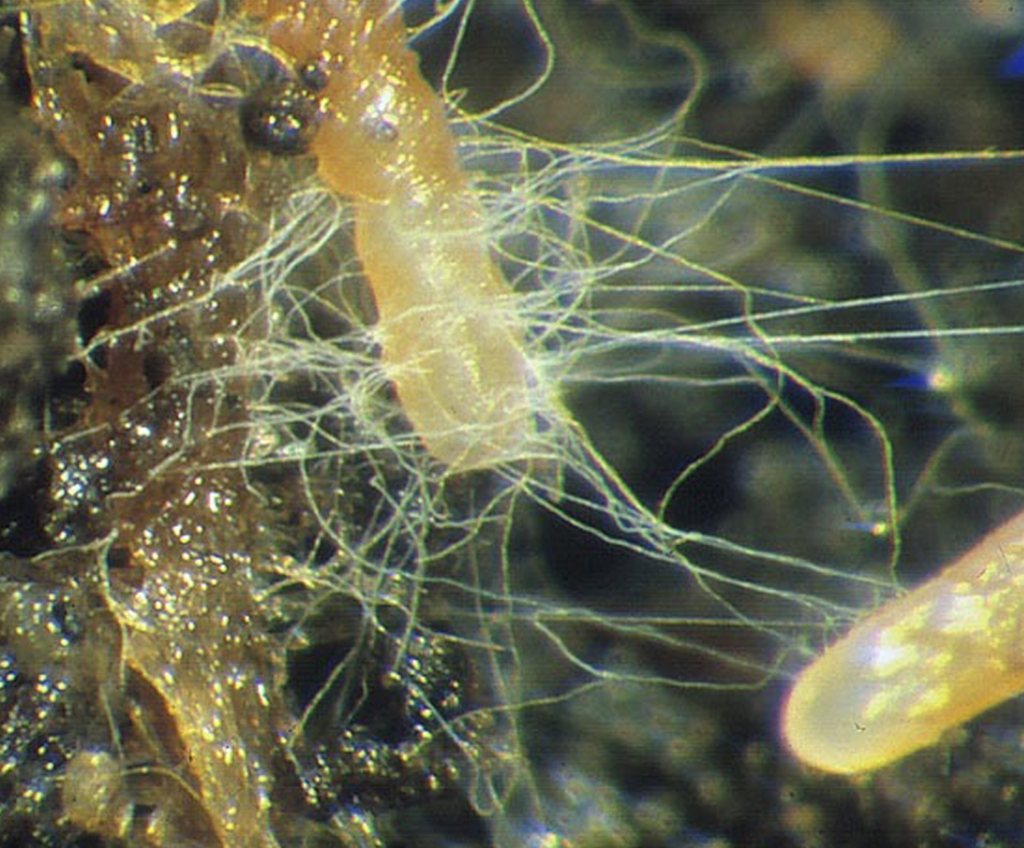
Across this network system, trees can share resources with other plants when they are in need. An experiment showed that Douglas firs (a very tall type of tree) transfer carbon to seedlings shaded from sunlight through fungal links, aiding them when they have low light [4]. Some other studies have suggested that plants can send chemical warning signals via the network when facing attack from pests, allowing surrounding trees to be able to increase their defences before they face the attacks next.
However, this is far from a one-sided discussion since some researchers believe that fungi favour trees that offer the best rewards for them, suggesting a less selfless and “kind” system, but more competitive as well as cooperative. No matter if altruistic or selfish, the fungal network is undoubtedly strong.
Another crucial role that fungi plays as well as networking is that of decomposition. Fungi are the world’s recycling organisms, breaking down dead matter, including leaves, fallen trees, and animal remains, and turning them into nutrients that are used to feed new life.
Fungi are some of the only organisms that have the ability to digest lignin – the tough compound material inside wood. Without this key role, forests would be covered in heaps of dead matter, leaving nutrients kept locked away. Researches have discovered that soil fungi help store massive amounts of carbon, equating to approximately 36% of annual global fossil fuel emissions, hugely decelerating the rate of climate change.
Whilst fungi have a crucial impact on forests and soils, they also have a role and shape in human society. Constantly, we rely on fungi in ways we hardly notice. For example, yeast – which makes bread rise and ferments the alcohol in both beer and wine – is extremely helpful and is used every day. Moulds give cheeses flavour and texture, and edible mushrooms are key points of certain global cuisines.
As well as this, fungi have also transformed the medicinal industry. Penicillin was discovered in 1928 by Alexander Fleming, revolutionising healthcare, and saving countless lives.
Despite the clear importance and value of fungi, fungi tend to be overlooked in daily lives. Policies and campaigns are dominated by plants and animals, whilst fungi are left in the dust. All of soil degradation, deforestation and climate change threaten fungal networks. In the hypothetical scenario in which fungi are lost, forests will massively weaken, soils would degrade, and ecosystems would unravel and struggle badly. Recognising this, the IUCN Fungal Conservation Committee has fought for fungi to be given equal attention in environmental protection as other kingdoms.
Looking towards the future, fungi could help us overcome modern day challenges. Fungi are the discrete and unnoticed architects of our world. They connect trees into living networks, recycle the dead into fertile soil, and provide humans with food, medicine, and future solutions. They are at once ancient and innovative, yet hidden all around us. Next time you see a mushroom pushing through damp soil, remember, it is only the visible tip of a vast, underground web, that hidden network is not just sustaining forests — it is sustaining us.