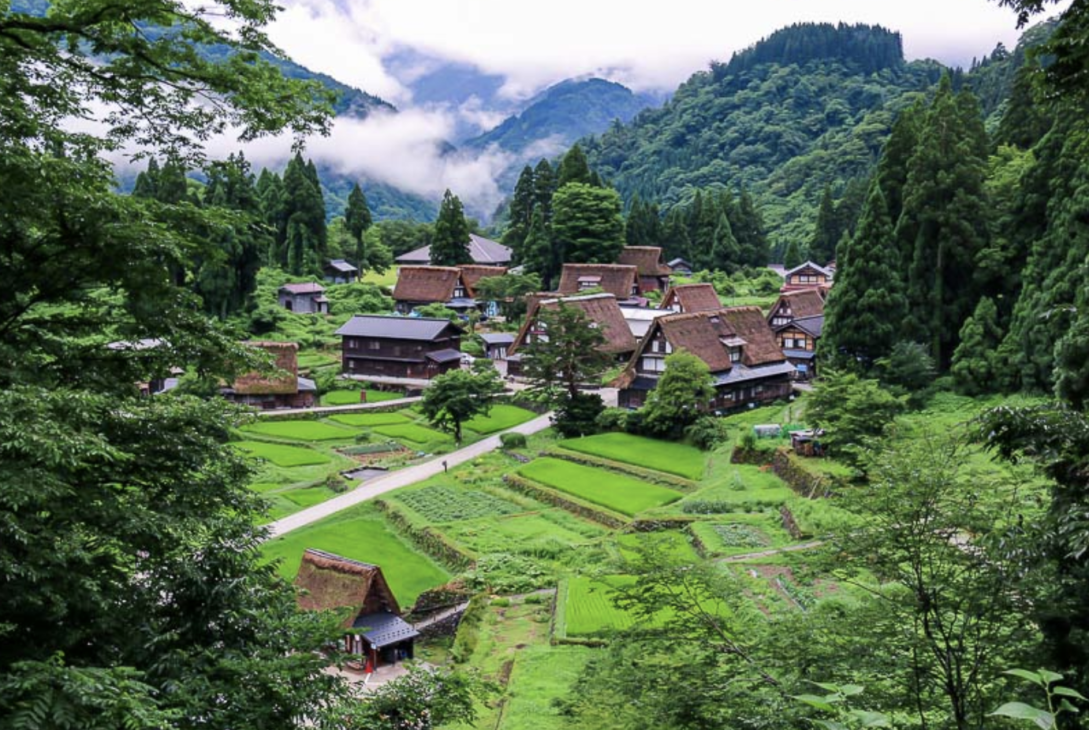
View of Ainokura Village from the lookout point | japan-guide.com
In a small village in the mountains of Tokushima, a group of people wait at the bus stop every day, yet none of them ever get on the bus. This is because they are scarecrows. To many, Japan is a country of busy megacities like Tokyo, but most of it looks nothing like this. In fact, around 40% of Japan’s 1,700 municipalities are now classed as “depopulated”[1], whilst thousands of villages have become 限界集落 (genkai shūraku), or “marginal villages”, where more than half of the residents are over 65[2]. So what happens to the environment surrounding these villages when the people who once looked after it disappear? This article will argue that depopulation may not simply give the land back to nature, but can instead create new environmental problems and perhaps, in some cases, new opportunities.
Nagoro: the Village of Scarecrows
The first example, Nagoro in Tokushima Prefecture, shows what happens to farmland when there is no one left to work it. When Tsukimi Ayano was a child, the village had around 300 residents, many of whom worked in forestry or on the construction of a nearby dam[1]; by 2019, however, only 27 people were left, the youngest being 55[1]. Ayano’s first scarecrow was made to stop birds from eating the seeds in her garden[1], and since then she has made hundreds more, now sitting by the roads, outside an abandoned grocery shop and even inside the primary school, which closed in 2012 after its last two pupils graduated[3]. Scarecrows, however, cannot farm, hence as residents disappear, more and more fields are left to grow wild. To some, this may sound like good news for nature, but this is often not the case. Flooded rice paddies work much like man-made wetlands, providing a home for frogs, fish, insects and water birds[4], something which is lost once the fields are abandoned. Furthermore, one study of abandoned rice fields in Japan found that the number and variety of species fell to 56-72% of their original levels, with plant diversity failing to recover even after 10-15 years[5]. So although a village like Nagoro may look greener, its land can actually support less wildlife than before.
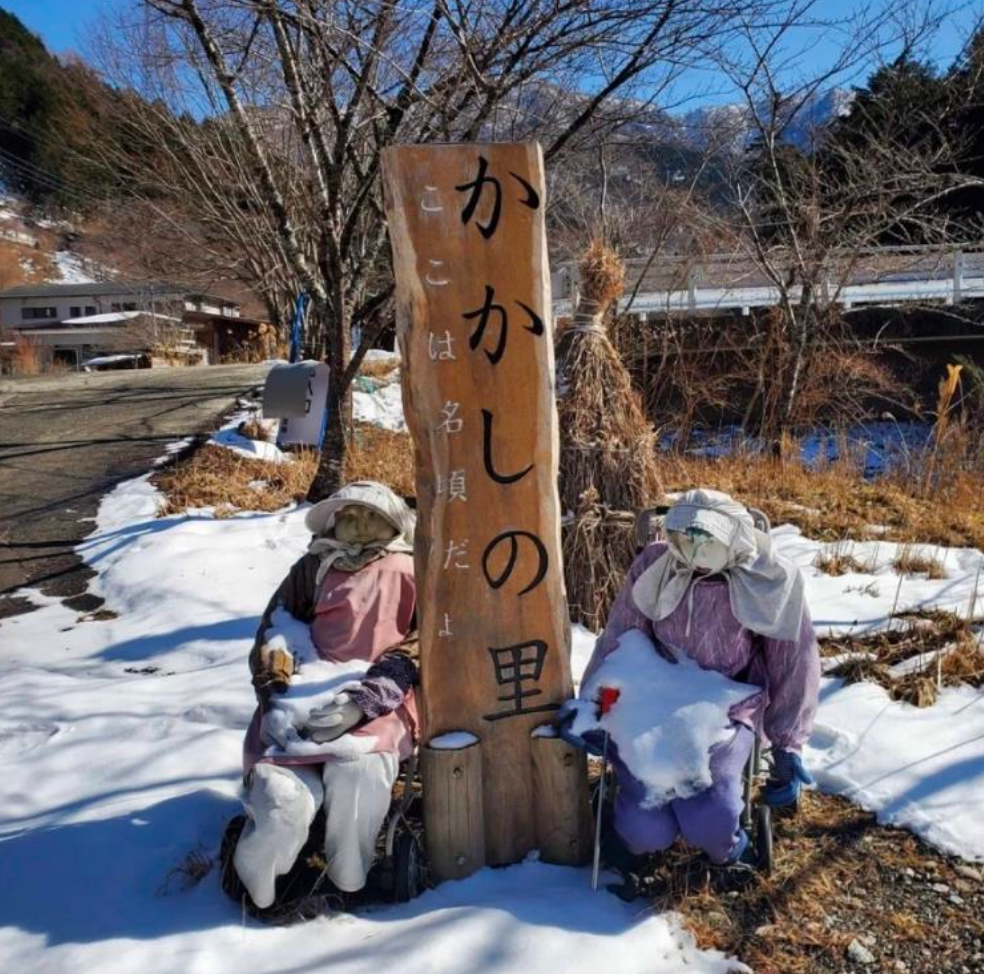
Scarecrows in Nagoro, Tokushima. Image source: [Frolicking Wanderer]
Akita: When the Bears Come Down
If Nagoro shows what is left behind, Akita, in northern Japan, shows what moves in. The prefecture has lost around a quarter of its population since 1990[6], and with it, many of the people who looked after 里山 (satoyama), which is the farmland, ponds and woods at the foot of the mountains that for centuries acted as a natural border between people and wildlife[6]. As this land is left unmanaged, the forest has crept closer to homes, whilst persimmon and chestnut trees on abandoned farmland now attract Asian black bears into villages[7]. This could have been beneficial to the bears as their population increased from approximately 15,000 in 2012 to around 44,000 due to the reforestation of areas which were no longer used by humans[8]. However, this has created conflicts. In 2025 there were 13 deaths caused by bear attacks in Japan (more than double the previous record of 6)[9]. This issue became so bad in Akita that they had to send soldiers to help with trapping bears[7]. This resulted in over 14,000 bears being killed in one year (almost three times the number killed the year before)[8]. The Japanese government now have a new policy to decrease the number of bears. They hope to reduce the population in the Tohoku region from around 19,000 to 12,000 by 2030[10]. Whilst initially the increase in forest cover allowed bears to flourish, the population may now be significantly decreasing.
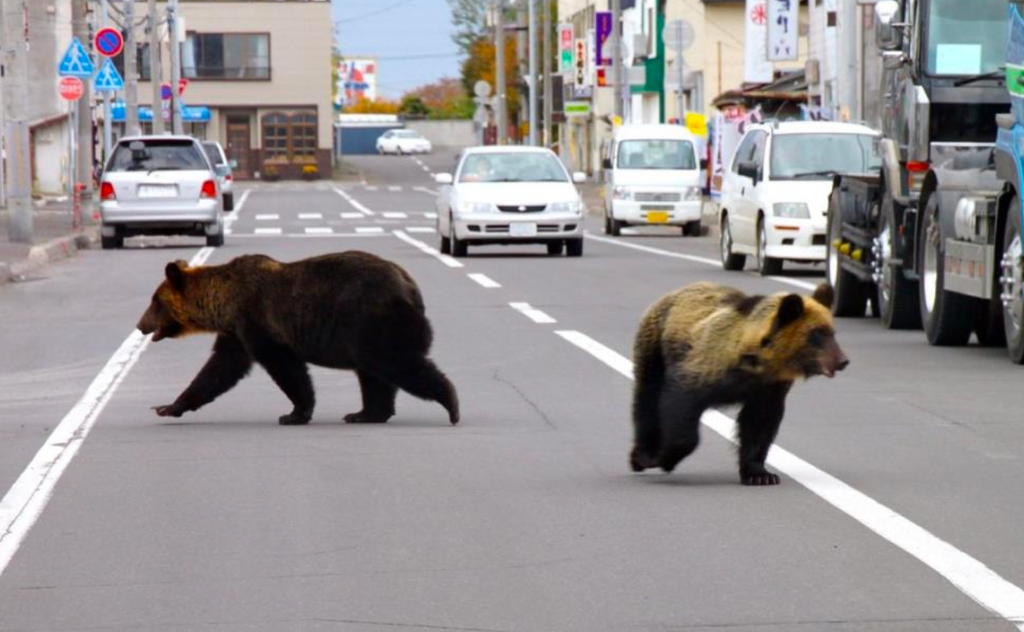
Brown bears crossing a road in Hokkaido. Image source: [SCMP]
Nishiawakura: Looking after the Forest
However, a shrinking population does not always mean a worse environment. Nishiawakura, a village of around 1,500 people in Okayama Prefecture, is mostly covered in forest, 84% of which was planted by people, mainly cedar and cypress[11]. After the Second World War, trees like these were planted across Japan to supply timber for building, yet cheap imported wood later pushed down the price of Japanese timber, with Japanese cedar now worth only about a quarter of its 1980 price[12]. This was significant because looking after these forests made no profit, and hence, with fewer and fewer foresters, many were simply left untended[13]. Planted forests need to be thinned, meaning that some of the trees are cut down so that the rest have more space and light; without this, the trees grow too close together, blocking sunlight from the ground, stopping undergrowth from growing and developing weak, shallow roots, which raises the risk of landslides[14]. In 2008, Nishiawakura responded with its “100-Year Forest” initiative, in which the village office manages forests on behalf of their owners and thins them out[11]. By 2019, over 1,600 hectares had been thinned, whilst leftover wood was being burned in boilers to heat the village’s hot springs and small hydroelectric plants were producing renewable energy[15]. As a result, more light can now reach the forest floor for plants to grow back, stronger roots can hold the soil together on steep slopes, and wood that would otherwise be wasted is used instead of fossil fuels. Therefore, when a village takes responsibility for its forest, depopulation can perhaps become a reason to look after the environment more carefully, not less.
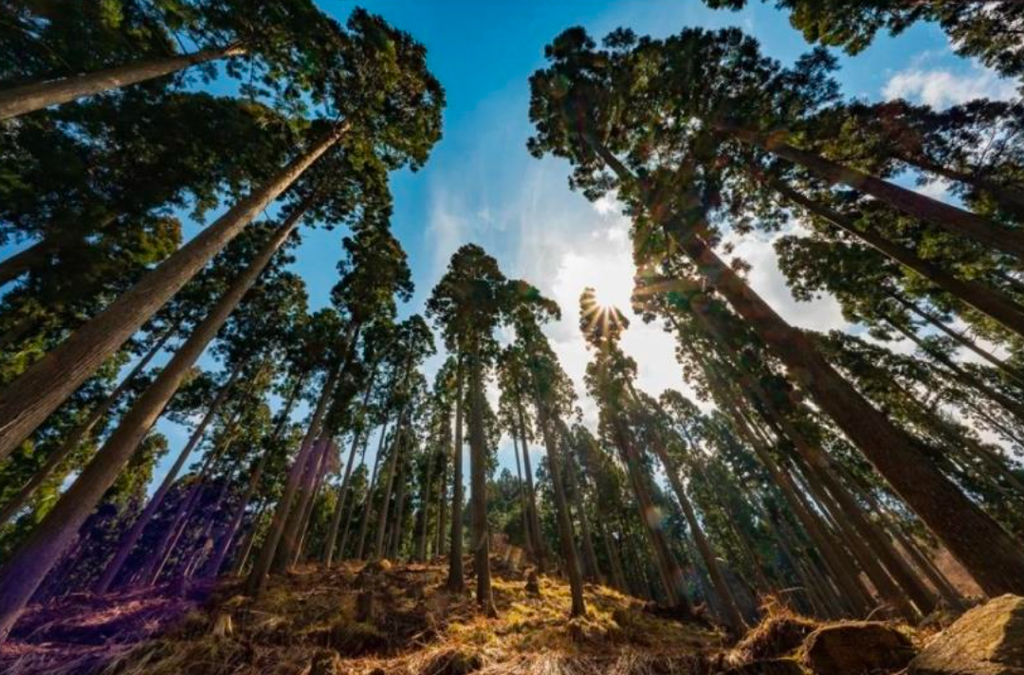
A cedar plantation forest. Image source: [Setouchi Travel]
Kamikatsu: the Zero-waste Town
Kamikatsu, also in Tokushima, goes even further, showing how a small population can become an advantage. Despite over half of its roughly 1,500 residents being elderly[16], in 2003 it became the first municipality in Japan to make a “Zero Waste Declaration”[17]. With the town never having had garbage trucks, residents compost their food waste at home and bring everything else to a waste centre, where it is sorted into 45 categories[17], hence Kamikatsu recycles about 80% of its waste, compared to a national average of around 20%[17]. This, however, relies on a small, close community in which everyone takes part, and it has not been easy; some residents complained that the constant sorting and washing would be too much for the elderly, whilst one poll found that 40% of residents were unhappy with at least one part of the policy[18]. This raises the question of whether such a system can last, since as the population continues to age and shrink, there may be fewer people able to sort waste so carefully, and it is uncertain whether a system that depends on everyone taking part could ever work in a larger town or city.
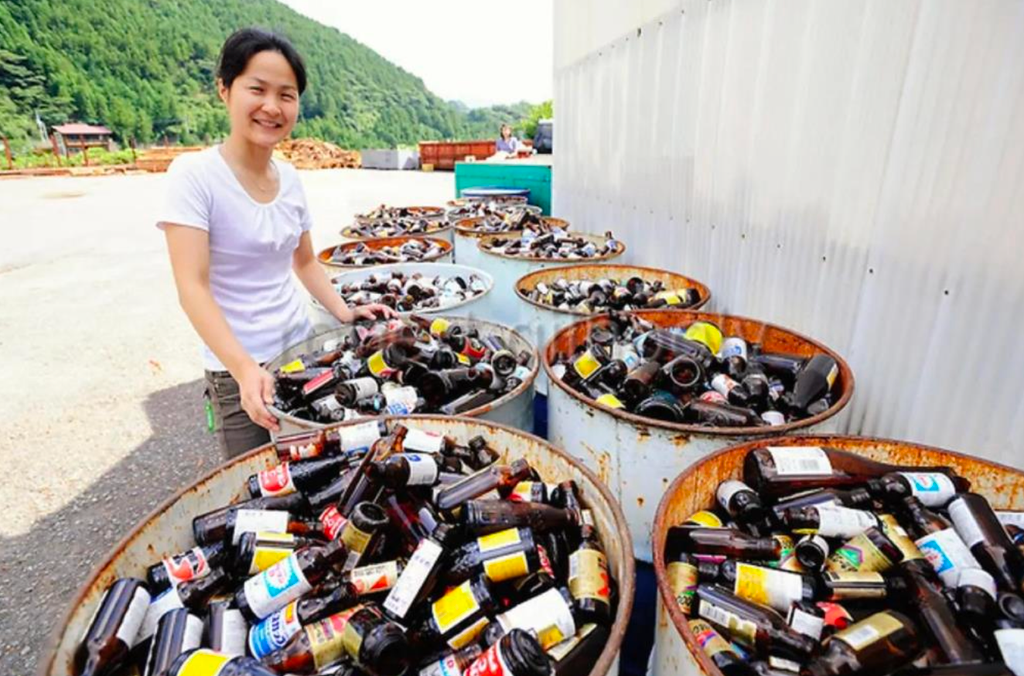
Bottles sorted for recycling in Kamikatsu. Image source: [SCMP]
Conclusion
Overall, the environment surrounding Japan’s shrinking villages has not simply returned to nature. In places like Nagoro and Akita, the loss of people has left fields and forests unmanaged, reducing the variety of wildlife on former farmland and bringing bears into direct conflict with the few residents who remain. Nishiawakura and Kamikatsu, however, show that a small community can still protect, and perhaps even improve, its environment if it organises itself carefully. Looking ahead, these problems may only grow, as Akita’s population alone is expected to fall by 40% by 2045[19], which could mean even more abandoned land and further damage to the environment. It is not certain what will happen; the scarecrows of Nagoro may keep the birds away for now, but the future of rural Japan’s environment will depend on the people who choose to stay.
Bibliography
Agence France-Presse, “Valley of the dolls: scarecrows outnumber people in Japan village”, Inquirer, 2019. https://newsinfo.inquirer.net/1107760/valley-of-the-dolls-scarecrows-outnumber-people-in-japan-village
Associated Press, “Japan deploys the military to counter surge in bear attacks”, 2025. https://www.gpb.org/news/2025/11/06/japan-deploys-the-military-counter-surge-in-bear-attacks
Chieko Koshida & Naoki Katayama, “Meta-analysis of the effects of rice-field abandonment on biodiversity in Japan”, Conservation Biology, 2018. https://doi.org/10.1111/cobi.13156
Council of Local Authorities for International Relations (CLAIR), “Collaboration with Local Venture Companies with the 100-Year Vision for Forests as a Base”, 2019. https://www.clair.or.jp/e/bestpractice/docs/2019Nishiawa_e_s.pdf
Foreign Correspondents’ Club of Japan, “Bearing Witness”, Number 1 Shimbun. https://www.fccj.or.jp/number-1-shimbun-article/bearing-witness
Hiroshi Nakamura & NAP, “Kamikatsu Zero Waste Center”. https://www.nakam.info/en/works/kamikatsu0/
Japan for Sustainability, “Nishiawakura Village: Initiative with a 100-year Vision of Forests”, 2018. https://japanfs.org/en/news/archives/news_id036016.html
Justin McCurry, “Sorting the rubbish 34 ways”, Dialogue Earth. https://dialogue.earth/en/?p=27335
Kyodo News, “Depopulating Japan gives bears room to roam, pushes policy shifts to cull”, Japan Today, 2026. https://japantoday.com/category/national/focus-depopulating-japan-gives-bears-room-to-roam-pushes-policy-shifts-to-cull
Kyodo/Yonhap, “Japan killed 14,000 bears after 13 people died in record attacks”, The Korea Herald, 2026. https://mbiz.heraldcorp.com/article/10856224
Naoki Katayama et al., “A review of post-war changes in rice farming and biodiversity in Japan”, Agricultural Systems, 2015. https://econpapers.repec.org/RePEc:eee:agisys:v:132:y:2015:i:c:p:73-84
NBC News, “Scarecrows Outnumber People in Tiny Japanese Village”. https://www.nbcnews.com/news/weird-news/scarecrows-outnumber-people-more-hundred-tiny-japan-village-n3245014
Nippon.com, “Cat Island: Felines Outnumber People 10-to-1 at This Tourist Attraction”. https://www.nippon.com/en/nipponblog/m00004/
Nippon.com, “Japan’s Forests: From Lumber Source to Beloved Resource”. https://www.nippon.com/en/features/c03913/
Papersky, “Japan Long Trail Walker: Inaba Kaido”. https://papersky.jp/en/japan-long-trail-walker-inaba-kaido
Agence France-Presse, “Hungry bears on the prowl: Japan confirms first deadly attack of 2026”, Malay Mail, 2026. https://www.malaymail.com/amp/news/world/2026/05/08/hungry-bears-on-the-prowl-japan-confirms-first-deadly-attack-of-2026/219239
Wood Central, “Carbon Finance Offers Lifeline to Japan’s Ailing Forest Sector”, 2026. https://woodcentral.com.au/japan-forestry-carbon-credits/
Worldcrunch, “Japan bear attacks: climate change and demographic collapse”. https://worldcrunch.com/green/japan-bears-attacks-environment/amp/