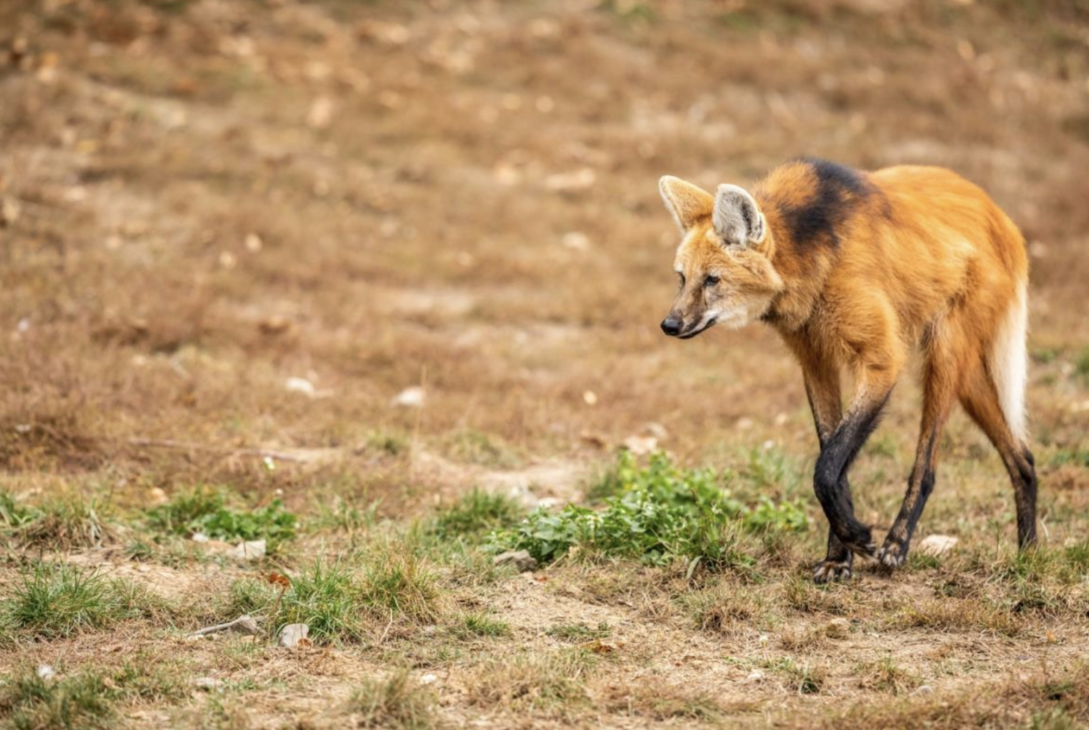
The highly elusive maned wolf, classed as Near Threatened on the IUCN Red List (pictured at Plzeň Zoo, Czech Republic). Photo: Zdeněk Macháček / Unsplash
The Cerrado region of Brazil is the most biodiverse savannah on the planet, and the second largest biome in the country. It is an ancient biome, housing around 12,000 plant species, of which around 40% are endemic, as well as many animal species. Recently, the biome has seen severe degradation, with around 50% of its original vegetation cleared or converted, and it faces as great a threat of destruction as the neighbouring Amazon rainforest, if not a greater one.
The Causes of Degradation
The largest cause of environmental destruction and degradation in the Cerrado region is the clearing of land for agricultural use. More than 50% of the original Cerrado land area is currently under agricultural use, mainly for cattle pasture and crops, and that figure is still growing. Furthermore, the modification of this biome has led to habitat fragmentation as roads and farms split natural habitats apart into isolated sections, and it has led to increased soil erosion, an imbalance in the carbon cycle and changes in the regional climate.
The three major meat companies in Brazil, JBS, Marfrig and Minerva, have been linked to the environmental devastation of the Cerrado. Global Witness found considerable illegal deforestation across their supply chains, with ranches supplying these companies havingcleared a combined area of forest larger than Chicago, 99% of it illegally. In Mato Grosso, the largest cattle herd and agricultural centre in Brazil, one in three cows from the Cerrado bought by one of the big three companies was farmed on illegally deforested land. All three companies dispute the findings.
Deforestation, both legal and illegal, is by far the largest factor in habitat loss for species in the Cerrado region, as native plants are replaced by pasture grass or single crops. Additionally, clearing of land leads to more environmental problems as it is often cleared with fire, a cheaper and easier process than slashing down plants, but it also leads to an increased risk of wildfires taking down even more land, and adds to climate change as trees and other plants are no longer available as carbon stores.
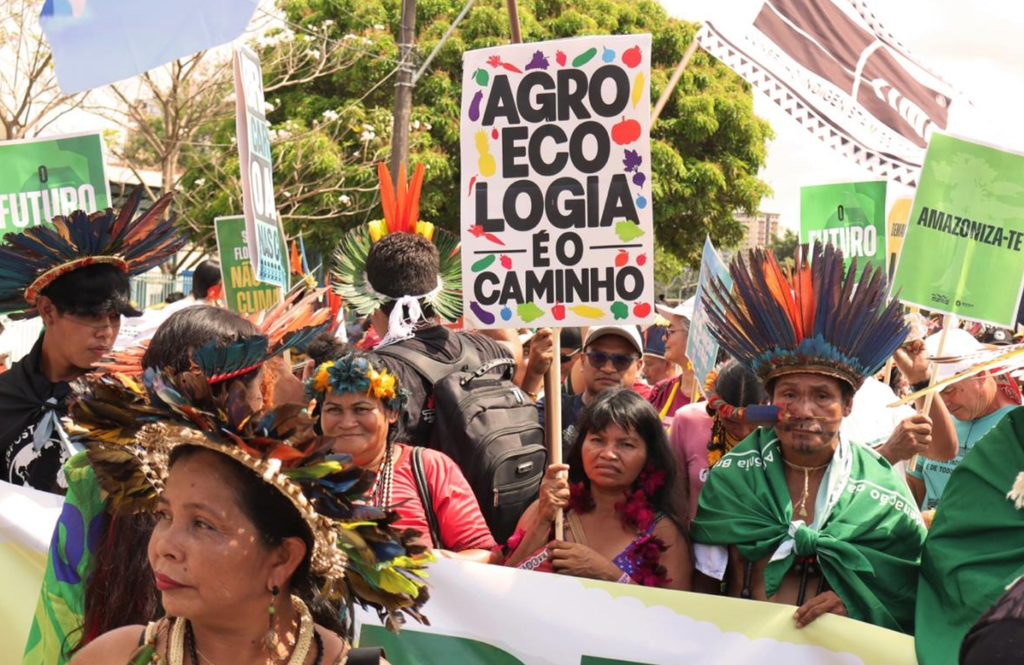
Demonstrators during COP30 in Belém, Brazil, in November 2025. The sign reads “Agroecologia é o caminho”– “Agroecology is the way” Photo: Mirna Wabi-Sabi / Unsplash
The Effects of Human Activity
In 2017, the Cerrado was estimated to store 13.7 billion tonnes of carbon dioxide. Since then, large-scale deforestation has likely released a large amount of this carbon into the atmosphere. Not only has the deforestation of the Cerrado region led to the endangerment of countless Brazilian plant and animal species, it has also led to the endangerment of animals and plants worldwide due to the amount of carbon released into the atmosphere, driving global warming.
The degradation of the Cerrado has led to a loss of a water source for millions of Brazilians, as the region acts as a natural water sponge. Plants with roots extending up to 15 to 30 metres deep store water underground during the rainy season and provide a groundwater source for Brazilian people and wildlife. However, as vegetation is lost in this region, its ability to store water is lost as well.
Today, only 20% of the vegetation in the Cerrado region remains fully intact, dismantling food chains in which there are 60 vulnerable animal species, with 12 classified as critically endangered. One of the most heavily affected, the critically endangered Brazilian merganser, has only 200–250 birds left in the wild. It is extremely sensitive to environmental disturbances, and can only survive in crystal clear water as it needs to be able to see its prey underneath the surface. Water quality changes due to construction and pollutants such as pesticides, fertilisers and residential sewage have threatened the species immensely, as many struggle to find food.
The effects of water quality changes and deforestation have resulted in serious threats to the survival of many species, including the Cerrado’s “big five”: the jaguar, giant armadillo, tapir, giant anteater and maned wolf. All five of these well-known large animals of the region, which play important roles in the ecosystem, are classified as Near Threatened or Vulnerable on the IUCN Red List.
Is there any hope for the Cerrado?
With extreme flora and fauna loss to the biome, regeneration is a very difficult task, especially as the base of the biome consists of extremely deep-rooted plants which require a large amount of time to grow. The Araticum Initiative, a coalition of more than 180 partners founded in 2020, is working to restore Brazil’s Cerrado region through natural regeneration, seeding and agroforestry. There are currently 31,000 hectares under restoration, but with a goal of 2,000,000 hectares, even with its recent UN recognition in August 2026, it does not appear likely that the goal will be reached. It is clear that there is much more left to do before the Cerrado will truly be restored, and while there are some efforts being made to save the biome, it still rests on a downward path towards destruction.
In 2025, deforestation fell 11.49% from the previous year, with 7,235.27 km² deforested, but this is only the second year in a row with a drop in deforestation, following the recent peak of 2023 where 11,011.69 km² was deforested.
Conclusion
The Cerrado has seen advanced degradation with the rise of meat industries in the last decades. This arises mostly from deforestation, which in turn reduces the region’s water availability. The situation of the Cerrado, while being much less under discussion than that of the Amazon, is increasingly disastrous, as deforestation rates stay high while the Amazon has seen less and less deforestation, apart from during Jair Bolsonaro’s presidency, which ended in January 2023. While there are efforts being made to protect the Cerrado, they currently have not been very impactful, and the most impactful solution to save the Cerrado is to reduce the demand for beef and dairy products from the region, so that the supply is no longer needed. In order to save the Cerrado, the world must change the way it eats.
Bibliography
Anache, Jamil A. A., et al. “Hydrological Trade-Offs Due to Different Land Covers and Land Uses in the Brazilian Cerrado.” Hydrology and Earth System Sciences, vol. 23, 7 Mar. 2019, hess.copernicus.org/articles/23/1263/2019/. Accessed 8 Oct. 2026.
Campos, Davidson P., et al. “Population Genomics of the Critically Endangered Brazilian Merganser.” PubMed, 6 Dec. 2023, pubmed.ncbi.nlm.nih.gov/38136797/. Accessed 9 Oct. 2026.
“Cerrado – Species.” Critical Ecosystem Partnership Fund, www.cepf.net/our-work/biodiversity-hotspots/cerrado/species. Accessed 5 Oct. 2026.
“The Cerrado Crisis: Brazil’s Deforestation Frontline.” Global Witness, 21 Feb. 2024, globalwitness.org/en/campaigns/forests/the-cerrado-crisis-brazils-deforestation-frontline/. Accessed 5 Oct. 2026.
“Deforestation’s Ripple Effect on Cerrado’s Biodiversity.” FAIRR Initiative, 14 May 2019, www.fairr.org/news-events/insights/cerrado-deforestation. Accessed 8 Oct. 2026.
“Greening Lands, Feeding People: UN Awards Three Restoration Flagships at UNCCD COP17.” UN Environment Programme, 26 Aug. 2026, www.unep.org/news-and-stories/press-release/greening-lands-feeding-people-un-awards-three-restoration-flagships. Accessed 13 Nov. 2026.
“In 2025, Deforestation Fell by 11.08 Percent in the Amazon and by 11.49 Percent in the Cerrado.” Government of Brazil, 30 Oct. 2025, www.gov.br/secom/en/latest-news/2025/10/in-2025-deforestation-fell-by-11-08-percent-in-the-amazon-and-by-11-49-percent-in-the-cerrado. Accessed 13 Nov. 2026.
Paula, R. C., and K. DeMatteo. “Maned Wolf.” The IUCN Red List of Threatened Species, 13 Aug. 2026, www.iucnredlist.org/species/4819/88135664. Accessed 9 Oct. 2026.
Pereira, Cássio C., et al. “The Cerrado Crisis Review: Highlighting Threats and Providing Future Pathways to Save Brazil’s Biodiversity Hotspot.” Nature Conservation, 9 Jan. 2026, natureconservation.pensoft.net/article/168273/. Accessed 9 Oct. 2026.
Santos, Gilsonley Lopes dos, et al. “Degradation of the Brazilian Cerrado: Interactions with Human Disturbance and Environmental Variables.” Forest Ecology and Management, 15 Feb. 2021, www.sciencedirect.com/science/article/abs/pii/S0378112720316443. Accessed 5 Oct. 2026.
“Save the Cerrado.” World Wildlife Fund, www.worldwildlife.org/places/Cerrado/save-the-cerrado-our-climate-depends-on-it/. Accessed 8 Oct. 2026.